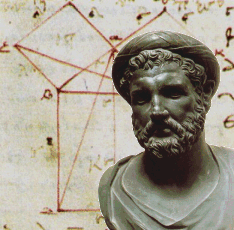
"Pythagoras was a great philosopher and mathematician of ancient Greece. He was born in the first half of the sixth th century BC, in island of Samos in Ionia.
Pythagoras settled in Croton in 529 BC. In this city, he founded a school of mathematics and philosophy and had many followers. It would have traveled a lot and went from one in Crete, Persia and Egypt. He stopped in Miletus, where he was a pupil of Thales. He coined the word "philosopher" to describe himself. Died around 500 BC to Metapontum. Pythagoras is remembered for having demonstrated a relationship in the triangle, the famous theorem of Pythagoras. His motto was "everything is number".
Pythagoras settled in Croton in 529 BC. In this city, he founded a school of mathematics and philosophy and had many followers. It would have traveled a lot and went from one in Crete, Persia and Egypt. He stopped in Miletus, where he was a pupil of Thales. He coined the word "philosopher" to describe himself. Died around 500 BC to Metapontum. Pythagoras is remembered for having demonstrated a relationship in the triangle, the famous theorem of Pythagoras. His motto was "everything is number".
INTRODUCTION
Moved by Gnana
Samba
The word philosophy is formed from two Greek words "philo" and "sophos," which respectively mean "love" and " wisdom "in French. Accordingly, it is logical and legitimate or fair to say that the linguistic origin of the word allows to say that philosophy is a statement made to love wisdom. But by whom and under what circumstances the outer life and inner life men who invented it is clear that it is a cultural product? If the word wisdom means knowledge or intellectual capacity to give an objective explanation, rational or subjective to what has happened to what happens or what could happen by highlighting the laws that govern the fact we are talking about, can we say that philosophy has a monopoly on love of knowledge? Science implemented in its various forms and sectors of the real expected Is not recognizable as the work of conscience and human reason, conscious of a lack of knowledge and a drunk desire to overcome his ignorance about the existence of the world and about human existence in the natural world that is constantly transformed by the work? In other words, that philosophy is love of wisdom is a universal truth, a truth but not enough to distinguish philosophical activity among others.
If this definition does not distinguish clearly the face of philosophy in all theoretical productions of men who aim to clarify what is and what might exist and what should be done under order of things do not be surprised by events, by any other single sign or groups of signs may still be distinctive, that is to say, define, stating that it still is or what she did ever, it is not today, and it would never be tomorrow without leaving the original route which undertook its founders?
"the property is based on our horizon" 


